

Looking back through our blog archives, it is fascinating to see how far the world of bioenergy has come. Nearly two decades ago, back in 2007, we published a brief updates page noting the addition of a new section dedicated to Covered Anaerobic Lagoons. At the time, we noted that while they felt like a specialised niche, a number of these systems had been built across the UK during the 1970s and 1980s for farm waste management, effluent treatment, and methane capture.
Fast forward to today, and what was once a retrofitted 20th-century experiment has evolved into a vital weapon for modern sustainable farming and climate action. Let’s take a look at the journey of the humble anaerobic lagoon—from its early historical roots to its massive contemporary revival.
The 1970s and 80s: The First Wave of Farm Biogas
The original interest in covered anaerobic lagoons in the UK didn't happen in a vacuum. The 1973 OPEC oil crisis sent global fossil fuel prices skyrocketing.
At the same time, the intensification of livestock farming (the rise of early Concentrated Animal Feeding Operations, or CAFOs) meant farms were suddenly producing vastly more liquid manure and slurry than traditional muck-heaps could handle.
Where Were They?
During the late 1970s and 1980s, early pioneers began experimenting with large earthen basins. Instead of leaving them open—which caused terrible odour issues and let valuable energy escape into the atmosphere—engineers began experimenting with early, heavy industrial plastic membranes to trap the gas.
The Location Profile: The majority of these early UK systems were installed on large-scale dairy and pig units across heavy agricultural regions like South West England (Devon, Somerset), Cheshire, and parts of Yorkshire.
The Pioneer Tech: These early systems were incredibly basic compared to today's technology. Because they were uninsulated, the bacteria relied entirely on ambient weather temperatures to work. This meant that while they were incredibly cheap to construct, gas production slowed down significantly during chilly British winters.
The Evolution: Then vs. Now
To understand how much things have changed, we have to look at how technology transformed a simple "hole in the ground" into a highly engineered bio-reactor.
| Feature | The 1970s / 1980s Approach | The Modern Closed-Loop System |
| Lining & Containment | Simple compacted clay or early, rudimentary plastic sheets prone to tearing. | Advanced, heavy-duty synthetic geomembranes (like HDPE) engineered to prevent ground leakage. |
| Gas Collection | Basic, passive floating covers used primarily for odour control, with simple low-pressure pipe venting. | Smart floating "bubble" covers that double as dynamic gas storage vessels, paired with automated pressure control. |
| Primary Driver | High fossil fuel costs (The Oil Crisis) and basic volume containment. | The Methane Pledge: Drastic reduction of agricultural greenhouse gases and strict watercourse protection. |
| Efficiency | Low winter efficiency due to zero insulation or artificial heating. | Integrated heating loops and modular setups that maintain optimal mesophilic temperatures year-round. |
Why Covered Lagoons Are Exploding in Popularity Today
For a couple of decades, the focus of the UK renewable energy sector shifted toward massive, multi-million-pound tank-based Anaerobic Digestion (AD) plants. These plants are incredible, but they require massive capital and rely heavily on feeding them crops like maize.
Today, there is a massive push to return to the simplicity of the lagoon, but with 21st-century tech. Companies like Cornwall-based Bennamann and Somerset-based QUBE Renewables (with their modular floating "lagoonQUBE" systems) are transforming existing farm slurry lagoons into clean energy hubs.
Modern systems allow small-to-midsize dairy farms to slap a high-tech floating cover over their existing waste pits.
Capturing fugitive emissions: It stops methane—a greenhouse gas over 25 times more potent than carbon dioxide—from escaping into the atmosphere.
On-farm energy independence: The captured biogas is scrubbed and used to power farm equipment, run Combined Heat and Power (CHP) engines, or even create liquid methane to run heavy tractors.
Protecting nutrients: The remaining liquid, known as digestate, becomes a highly stabilized, low-odor natural fertilizer that reduces the farm's reliance on expensive, synthetic chemical fertilizers.
The Verdict
When we wrote that quick update in 2007, covered lagoons were viewed almost as a historical stepping stone. Today, they represent the future of decentralized, small-scale farm energy. By taking the low-cost, land-friendly philosophy of the 1970s and combining it with modern engineering, agriculture is finally closing the loop on waste.
_______________________________
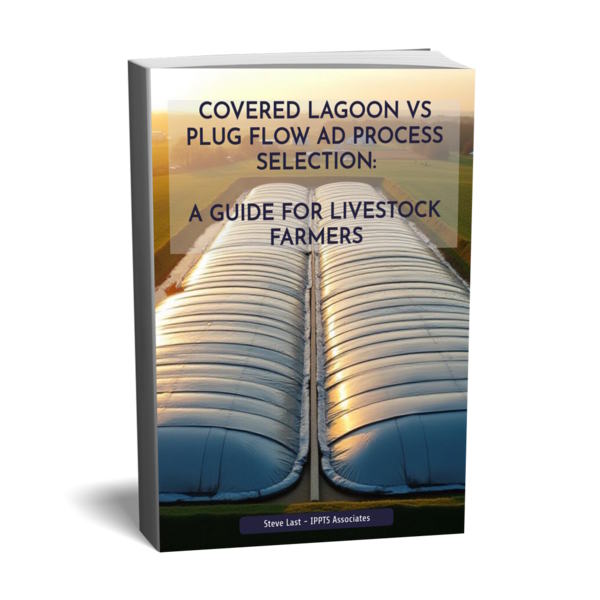
The guide addresses a decision-making gap for farmers and managers considering investments in anaerobic digestion systems, providing detailed analysis of the operational, economic, and environmental characteristics that distinguish these competing approaches.
Click to see more at our GumRoad Store
Selecting the best choice between covered lagoon and plug flow digester operation has become increasingly important as both systems gain traction across the livestock sector. According to regulatory statistics, plug flow digesters currently dominate dairy operations in the United States, processing manure from over 260,000 dairy cattle at approximately 91 sites.
___________________________________From time to time we add additional Anaerobic Processes to the process section of the Anaerobic-Digestion.Com web site.
We have now added a page about the use of covered anaerobic lagoons of which there were a number built in the UK during the 1970s and 1980s on farms and for effluent treatment, plus methane gas production.
You are welcome to visit the web page which is here, and if you have more information to give us for publication about this type of treatment please do send it to us for publication.


 of the Covered Anaerobic Lagoon)
0 Comments